This Saturday, October 14th, a solar eclipse will be seen travelling across the North and South American continents. The “ring of fire” will begin around Eugene, Oregon and travel through San Antonio, Texas, before passing over Central and northern South America and ending above the easternmost coast of Brazil. The entire eclipse will last nearly six hours during its travels.
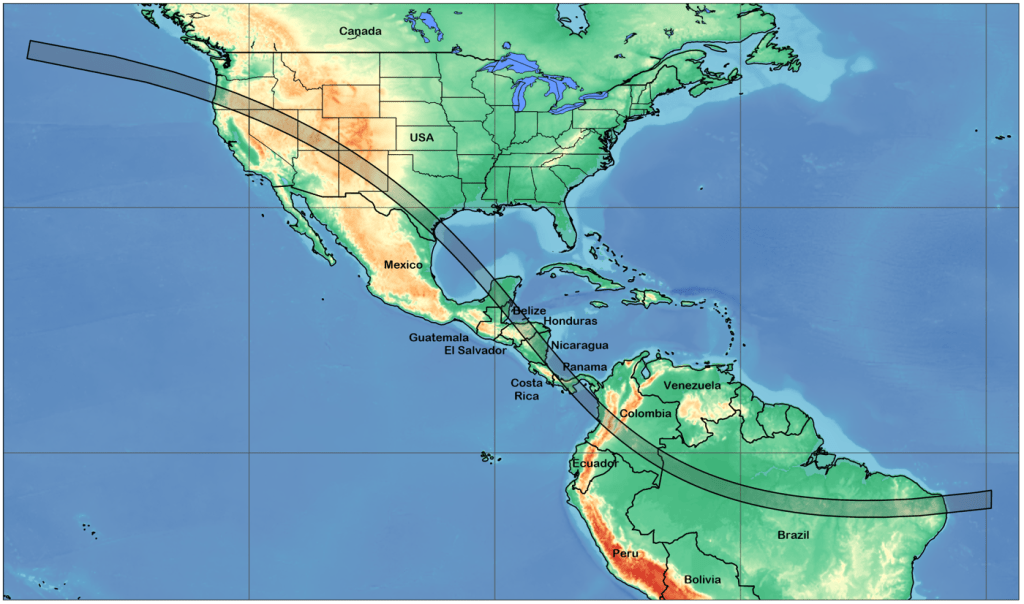
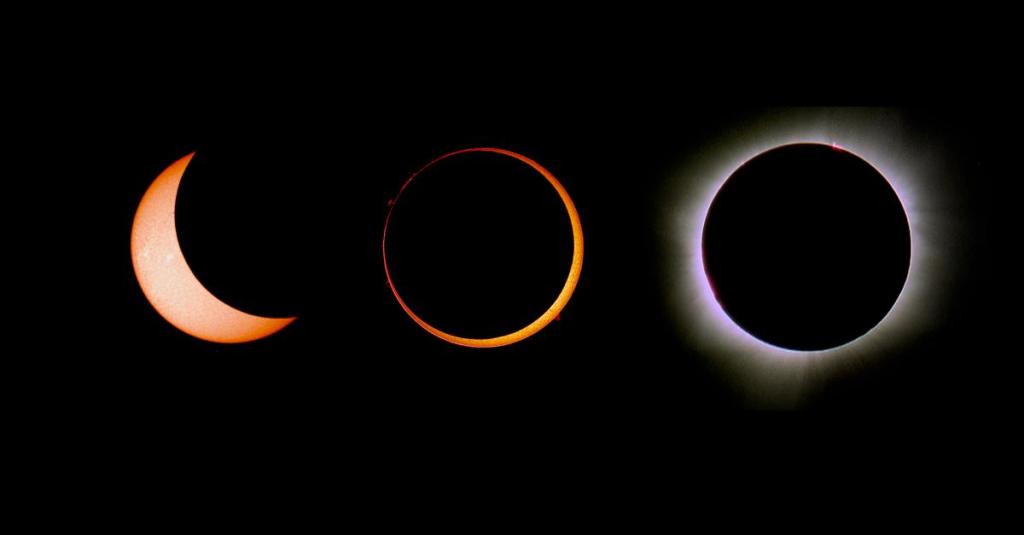
However, this is a very different type of eclipse than the one that made headlines in the summer of 2017. That was a total solar eclipse, where the Moon completely blocked out the sun for a few minutes. This will be an annular solar eclipse, where the moon nearly covers the sun.
You might ask: so what? An eclipse is an eclipse! What difference does it make?
Apparently, at least 12,000 miles.
First things first: in order for eclipses to even happen, the Earth, the Moon and the Sun all need to be in the same plane, with the Moon in between the Sun and the Earth. This allows for the Moon to cast its shadow on the Earth’s surface, and there are three different types of shadows that the Moon produces. Depending on which type of shadow you are beneath, you will see a different type of eclipse.
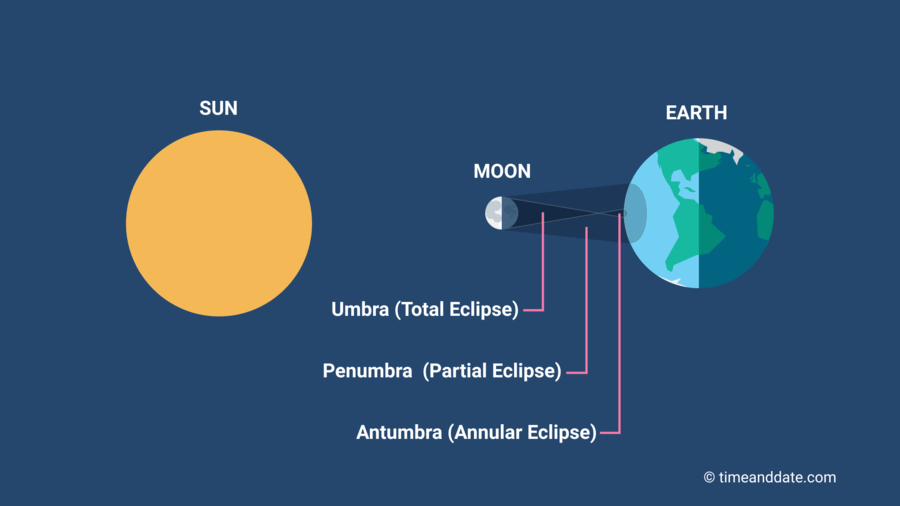
The dark, central section of the shadow is called the umbra, which is responsible for creating total solar eclipses. From the surface, the Moon is larger than the Sun and completely blocks out the sunlight. The penumbra, the outer, lighter shadow the Moon creates, produces partial eclipses, which look as if a circular chunk of the Sun was removed. The Moon’s half-shadow, or the antumbra, creates an annular eclipse when the Moon is slightly too small to completely cover the Sun.
Hybrid eclipses are a technical fourth type of eclipse, but those arise due to the Earth’s surface being curved, so an observer will witness a sequence of the other types (partial to annular/total and back) over a period of time.
In order for a total eclipse to occur, there is a maximum distance that the Moon can be away from the Earth and still produce a total eclipse. The Sun is roughly 400.8 times larger than the Moon, so a total eclipse occurs as long as the distance from the Earth to the Moon is at least 1/400.8 of the distance to the Sun (1 AU or astronomical unit), or about 234,000 miles away. On Saturday, the Moon will be about 246,000 miles from the Earth, twelve thousand too far for a total eclipse, so an annular eclipse will be seen instead.
Millions of years from now, however, total eclipses will cease to exist. Due to tidal effects, the orbit of the Moon around the Earth increases by about 1.5 inches (or 3.8 cm) every year. This means that, eventually, the Moon’s umbral cone will be unable to reach the Earth during eclipses, so all eclipses will be either partial or annular. But that will not happen in any of our lifetimes, so there is no need to worry.
The next total eclipse will happen next year in April, over Mexico and the eastern United States, not too long after this weekend’s annular eclipse.
 Space Savvy
Leave a comment