On Friday, October 13th, 2023, NASA launched another mission towards an asteroid. This time, scientists plan on exploring Psyche, the sixteenth asteroid ever discovered back in 1852, which is orbiting the Sun in the Asteroid Belt in between Mars and Jupiter.
Psyche is one of the largest asteroids in the Solar System, estimated to be about 173 miles (280 km) at its widest, and 144 miles (232 km) at its longest. It was chosen as the target for this mission, not only due to its size, but also its composition. Through observations through radar and heat radiation, it has been hypothesized that Psyche is made of metals (most likely iron and nickel) and silicates (the material that makes up sand and glass). Psyche is the largest known asteroid in our Solar System that is metal-rich.
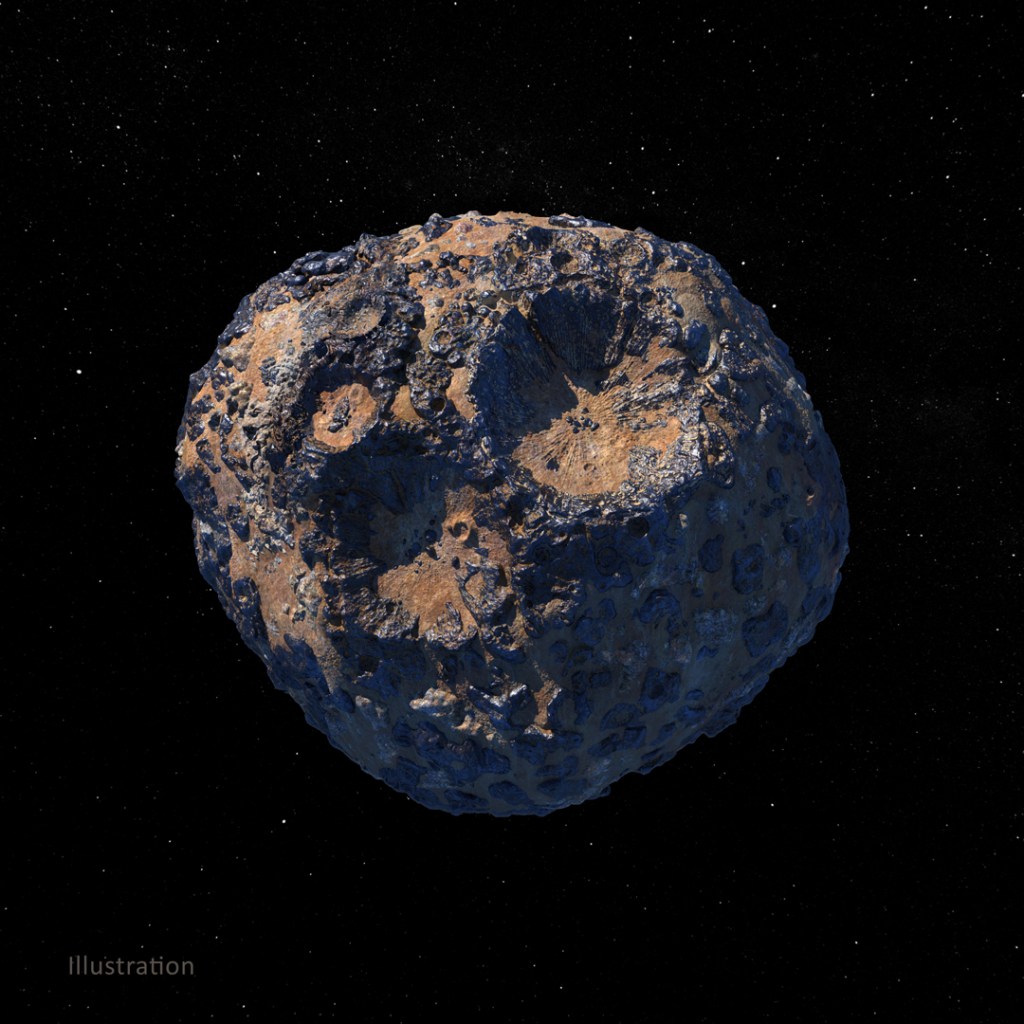
It has been theorized that, due to the immense size and the large amount of metal in the asteroid, that Psyche is the remains of a protoplanet’s core. During the birth of the Solar System, Psyche survived many collisions with other interstellar bodies, but that resulted in the death of the protoplanet. When the Psyche satellite completes its mission, it should prove whether this theory is correct, and if it’s true, then the data will give further insight into how planets, especially terrestrial (or rocky) planets, form.
Also in this mission, NASA plans to experiment with a new way to transmit information in space. The Psyche satellite is fitted with an upgraded system called Deep Space Optical Communication (DSOC).
Up until this mission, NASA has almost exclusively used radio waves to communicate with its equipment beyond the Earth-Moon system. Unfortunately, the amount of data that scientists want to collect from missions is beginning to exceed what can be transmitted in a reasonable amount of time. That is why DSOC will use lasers to run preliminary transmission tests while aboard Psyche.
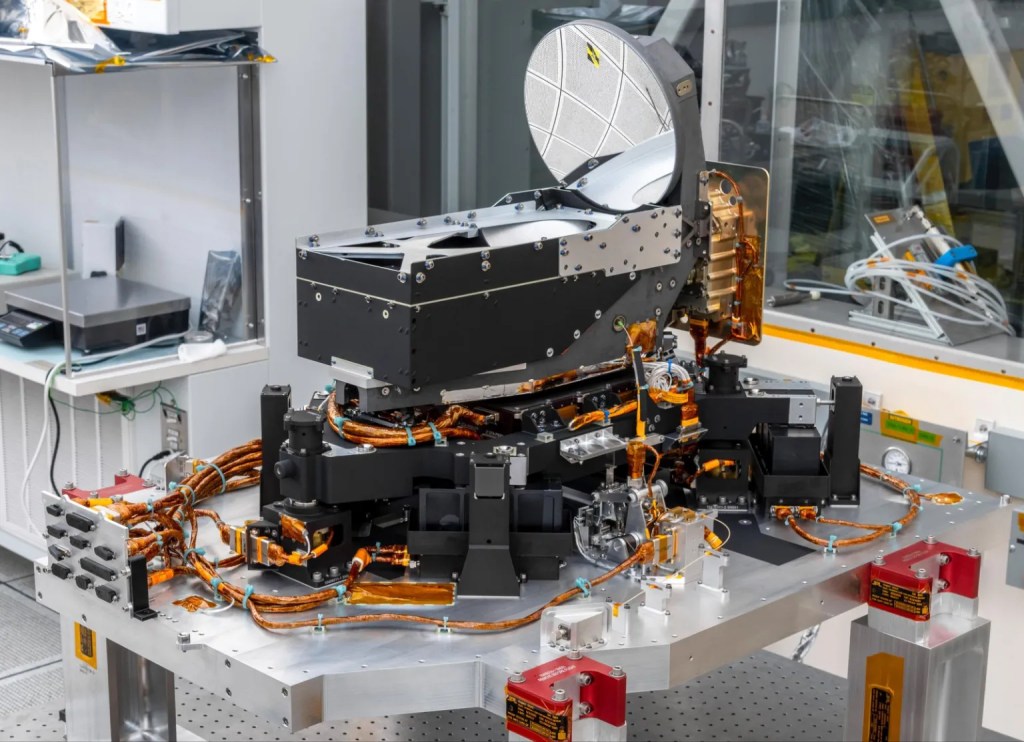
In a similar way to how fiber optic cables transmit allow for high-speed communication, DSOC will receive and send laser signals to and from repurposed telescopes. Data transmission will increase not because of the speed of the signals (radio waves are a form of electromagnetic radiation, or light), but because of the higher bandwidth the lasers provide. About 10 to 100 times more data will be able to transmitted over the same amount of time, along with higher fidelity images and videos.
Scientists are eager to test this technology during the Psyche mission due to a Martian fly-by that it will perform en route to the asteroid. NASA is hoping to use this technology on future manned missions to Mars for more efficient communication and video feedback. This laser system has never been used for distances longer than the Moon’s orbit, so it is vital to test this technology before we get there.
However, there will be some new challenges that scientists will face with DSOC. Unlike radio waves, which travel in all directions, lasers are hyper-focused to travel in only one direction. Pairing that with upwards of twenty minutes worth of lag between transmission and reception, means that the direction signals are sent will need to be very precise in order for any information to be collected. If successful, this form of communication in deep space could be revolutionary.
After its launch on October 16th, 2023, Psyche will take nearly three years to reach Mars in May 2026. It will then slingshot towards the asteroid of the same name, before arriving in August 2029, traveling over 2.2 billion miles (3.5 billion km).
 Space Savvy
Leave a comment