On September 24th, 2023, a capsule descended onto an empty Utah desert. Empty, except for the teams of NASA and Air Force scientists waiting to recover its contents. Inside was the culmination of the OSIRIS-REx mission that spent seven years in space.
The mission was initially green-lit back in 2011 as the third mission of NASA’s New Frontiers program, which looks to fund medium-sized spacecraft to better understand our Solar System. The OSIRIS mission planned to orbit and land on an asteroid close-by, and return with a sample from its surface.
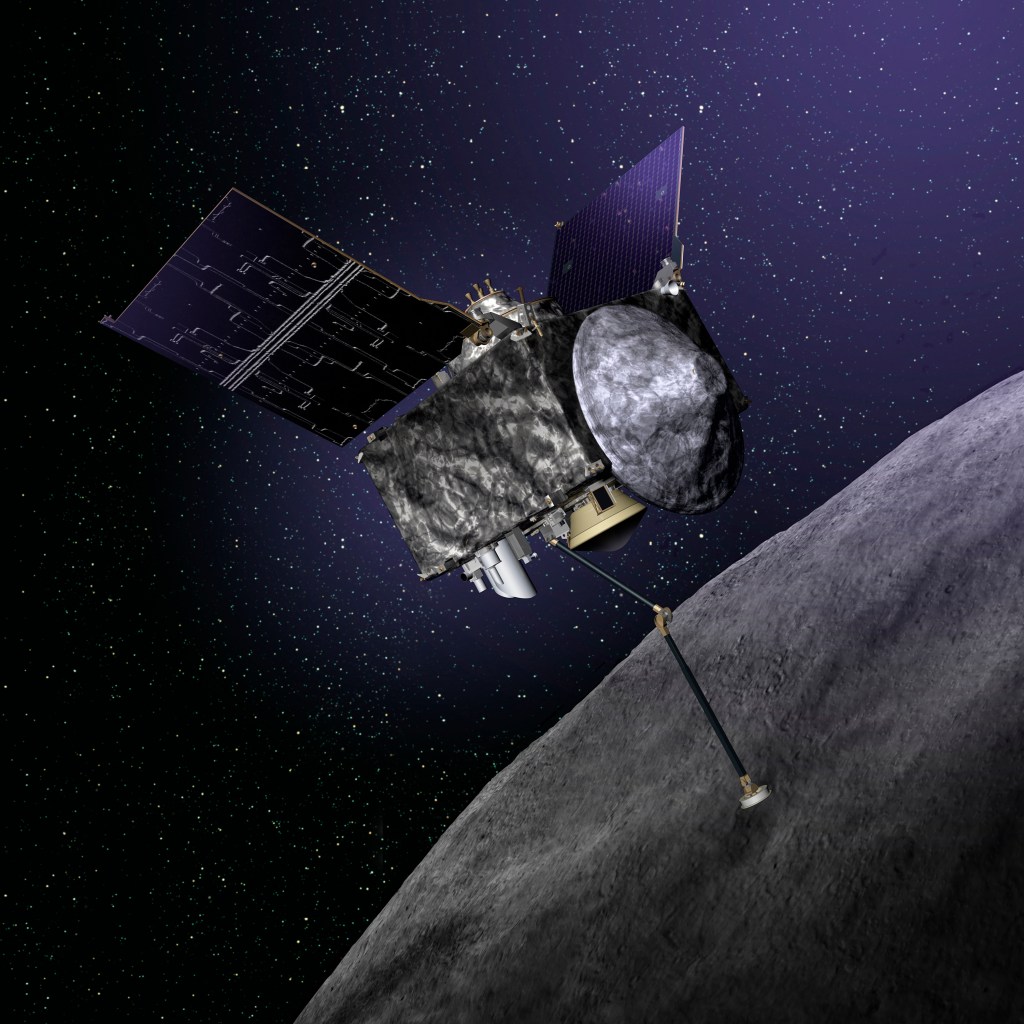
Bennu was selected for this mission for many reasons. First, its orbit is in close proximity to the Earth, with the two bodies being “close” every six years. Also, due to its proximity, Bennu is considered a potentially hazardous impact object, so understanding more about these nearby asteroids can give us more knowledge if we ever find ourselves in an Armageddon-like scenario.
Finally, the asteroid is made of rich, carbon-based material, with is similar to the asteroids that crashed into proto-Earth (Earth in its first billion years of existence). These asteroids are thought to have brought water and other organic materials that helped start life on our planet, so studying Bennu could provide answers to one of science’s fundamental questions: How did life begin?
Other missions from this program include: New Horizons, which famously took high-fidelity pictures of Pluto in 2015, Juno, which orbits Jupiter and analyzes its clouds, and Dragonfly, which will launch in 2027 to land on Saturn’s moon, Titan.
The satellite launched on September 8th, 2016, tracking toward Bennu, a near-Earth asteroid orbiting the Sun at about 105 million miles, which is only slightly further than the 93 million miles the Earth orbits at. It is one of 200 objects that scientists know the orbit and is similar to Earth’s.
OSIRIS began orbiting Bennu on December 3rd, 2018, nearly two years after launch. With only a diameter of 1640 ft (500m), Bennu is the smallest body that has ever been orbited by a satellite. (For perspective, the Empire State Building is only 1454 ft from base to tip.) OSIRIS also had an extremely close orbit to Bennu due to its small size, with an orbit height of only a mile, which was another record.
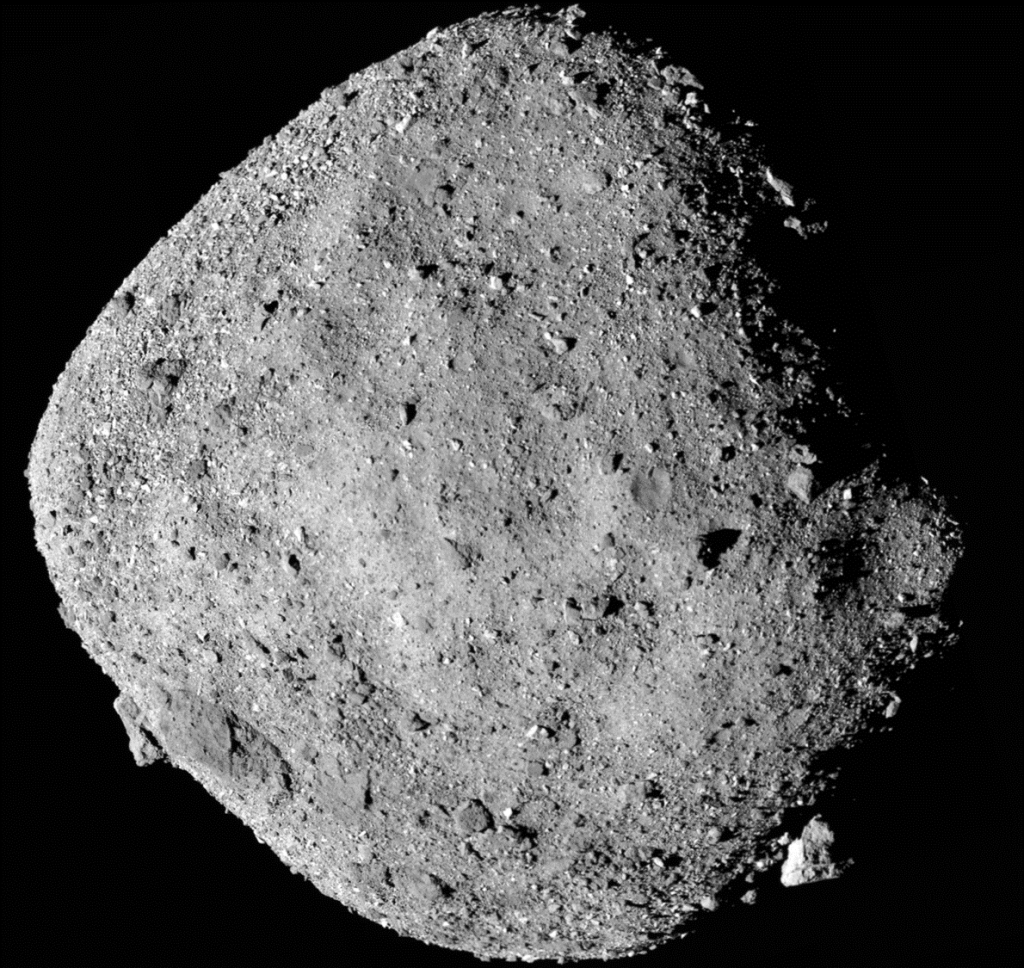
While in orbit, OSIRIS used five instruments to capture data. The satellite’s camera suite (OCAMS) captured the image above, and scanned the surface with a laser altimeter (OLA) to map the terrain and find the best functional place to land. The other three instruments were used to map the compounds and elements found in the asteroid to find the best place to sample. The visible and infrared spectrometer (OVIRS) hunted for organics, the thermal emission spectrometer (OTES) took Bennu’s temperature and hunted for chemical abundances, and the x-ray imaging spectrometer (RExIS) searched for abundances for individual elements.
OSIRIS touched down on Bennu on October 20th, 2020, after spending another two years in orbit, for only just six seconds. This was still enough time for the satellite to collect over 2 ounces (60 grams) of material by blasting nitrogen gas from is robotic arm (TAGSAM). The sample was shot back up into a collecting chamber, and OSIRIS began its journey home.
The sample landed safely in the Utah desert on the 24th of September, 2023. NASA plans on revealing the contents of the sample on October 11th.
The OSIRIS-REx mission will continue, with it already travelling to its new destination, Apophis, another near-Earth asteroid. It should arrive some time in 2029.
 Space Savvy
Leave a comment