Christopher Nolan’s space epic, Interstellar, is a movie that prides itself on its scientific accuracy. One of its producers, Kip Thorne, a theoretical astrophysicist who won the Nobel Prize in Physics back in 2017, consulted Nolan on all the physics concepts explored in the film. He and his team even invented a new rendering software to produce the truest images of a black hole five years before the now-famous photograph was taken.
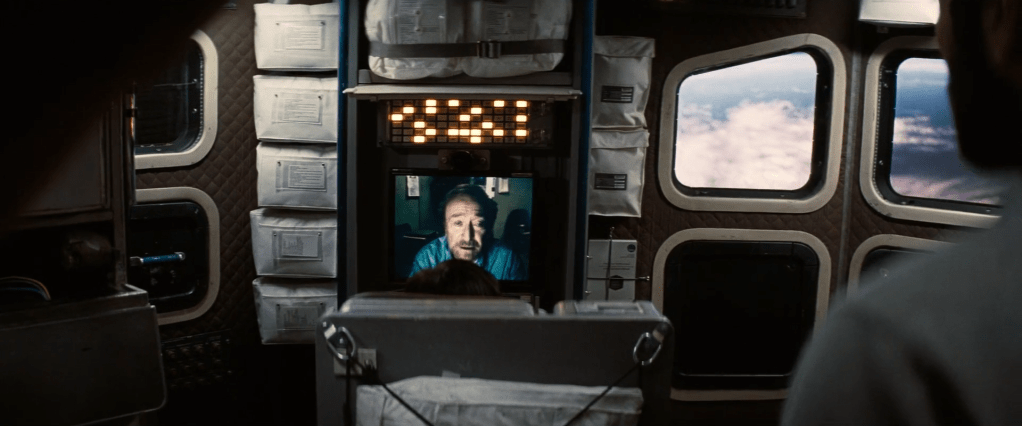
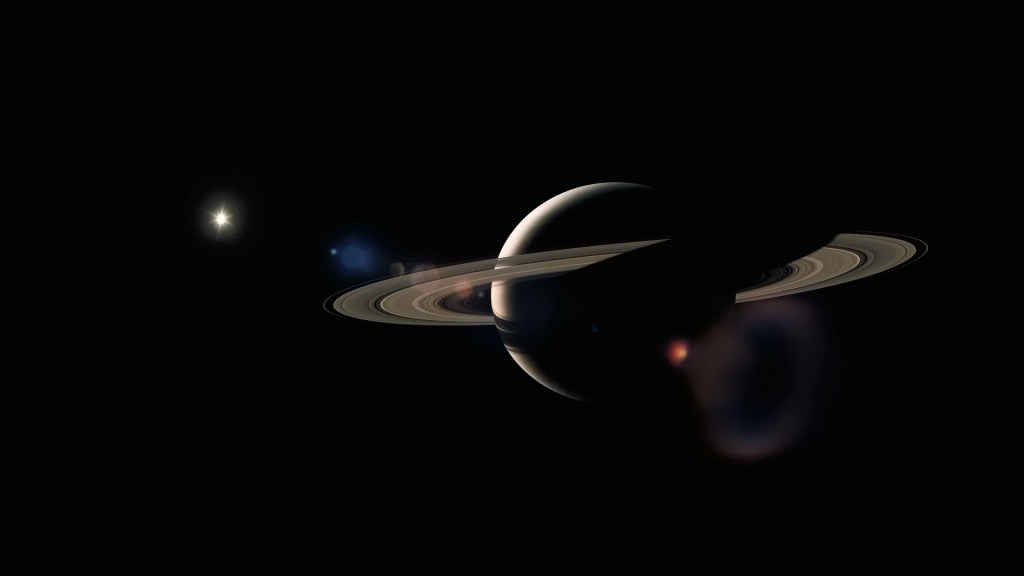
Yet with all of the scientific accuracies displayed in the movie, and all the books and research papers published during its production, there was one thing that caught my attention. When Cooper, played by Matthew McConaughey, and his crew board the Endurance, their ship, for the first time, they have a virtual meeting with Professor Brand, who is the leading scientist at NASA. He tells them that NASA predicts that it will take two years to reach Saturn, the closest planet to the wormhole.

Last month, NASA launched a satellite called Psyche, which will travel to an asteroid of the same name between Mars and Jupiter. On the way, it plans to test a new communications system when it reaches Mars, a much closer planet to the Earth than Saturn, in 2026, three years from now.
With today’s technology, is it even possible to reach Saturn in two years? Or is it only a rare case of movie magic in a film that prides itself in scientific accuracy?
First, we should break down how you move in space. If you are just floating, substantially far away from anything, no forces would act on you, which means simply that you would not move, at least not laterally. Sure you can flail your arms and kick your legs, but that would only spin you in a rotational motion, leaving your center of mass still. To achieve any sort of lateral movement, you need to be acted on by an external force to change your state of rest into one of motion.
This idea is known more simply as Newton’s First Law of Motion. An object at rest will stay at rest until acted on by an outside force. This results in a change in velocity: you go from having no speed to having some. This, by definition, is acceleration, and is the basis for this thought experiment.
Now, there are three possible ways to accelerate, space or not. You can accelerate at the very beginning until you reach a speed that can coast you to a destination. You could also slowly accelerate over the course of the entire journey, with your velocity always increasing. Or, you could have a combination of the two, accelerating intermittingly through the journey in short bursts and coasting in between.
Let’s try the first option, accelerating to a top speed that would carry us to Saturn in two years. Let’s also assume that Earth and Saturn are at their closest, so there’s less distance to travel, making this goal much more manageable. The top speed we would need to reach would then be:

Just for comparison, the Lockheed SR-71 Blackbird, the fastest plane in the world, has a top speed of 2200 mph, twenty times slower than what’s needed to reach Saturn this way. Sounds like we need to break a record.
Let’s accelerate to 42.5 thousand mph by the time we leave the atmosphere. That way drag will no longer slow us down since we are in the vacuum of space. Considering that the edge of the atmosphere is about 100 km away from the Earth, then we will need to accelerate a rate of:

which is impossible to survive, unfortunately. The average person can only withstand G-forces between 4-6 G, while fighter pilots, after lots of training and conditioning, can withstand up to 9 G, but only for a few seconds. SpaceX’s Dragon capsule, powered by a Falcon 9 engine, experiences between 3.5-4.5 G when flying astronauts to the International Space Station.
Experiencing high levels of G-forces are detrimental to your health and can be fatal, no matter which direction you are experiencing them. Vertical G-forces at lethal levels stop blood flow towards or away from your heart, overpowering the muscle. Horizontal G-forces have been known to break bones, shift organs and/or burst vessels, causing serious internal damage.
So, if we can’t accelerate all at once, why don’t we do it gradually? The G-forces you would experience would be significantly smaller:

so much so that you wouldn’t really feel it. But when you’re in the deep expanse of space, far away from anything, the only source of acceleration is the burning of your ship’s fuel. How much fuel would you need for this to work?
Well, let’s be rocket scientists for a bit and use one of their most important equations. The rocket equations showcases how much a rocket can change speed depending on its mass (with and without fuel) and the speed the gas from the burnt fuel leaves the rocket (exhaust velocity).
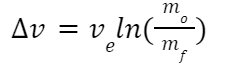
Since SpaceX’s Starship rocket will be used for NASA’s upcoming Artemis missions to the Moon and is also planned to be used for Mars in the distant future, we’ll use it’s data for these calculations. Starship, when completely emptied, weighs 120 tons and can take a maximum of 1200 tons of fuel with it. The ship also has multiple exhaust velocities depending on if the rocket is experiencing air resistance or not (3280 m/s if it is, 3750 m/s if it isn’t). Rearranging the equation to solve for the amount of mass needed for this trip, we get:

which is more fuel that what Starship can take.
Why not just build a bigger rocket to hold that extra fuel? Besides the fact that Starship is already the biggest and most powerful rocket ever built, and that the amount of fuel necessary for this trip is just absurd, a bigger rocket means a heavier rocket. If the rocket is heavier, then it needs more fuel to launch and accelerate, which then makes it heavier, and the feedback loop would just continue. Rockets are engineered in such a way that maximizes this delicate balance, and adding any more weight breaks that balance, rendering the rocket useless.
Therefore, the only possible way that we could reach Saturn in two years would be some combination of the two previous scenarios: an initial acceleration to get off the Earth, and at least one more to accelerate the rest of the way.
Given the mass limitations of Starship, how fast could it go with maximum fuel? First we need to differentiate its velocity before and after it reaches space. Assuming a maximum acceleration of 4.5 G (the upper limit on the Dragon capsule), Starship would be moving at a velocity of

at the edge of the atmosphere, 100 km off the ground. Achieving that velocity would require

of fuel, and if we burn the rest of the fuel continuously, the ship would accelerate another

bringing the total velocity of Starship to just over eleven kilometers per second (v = 11006.9871 m/s), or over twenty-four and a half thousand miles per hour (v = 24621.929 mph). This whole process would take just over four minutes, and we will be traveling at that speed for the time being.
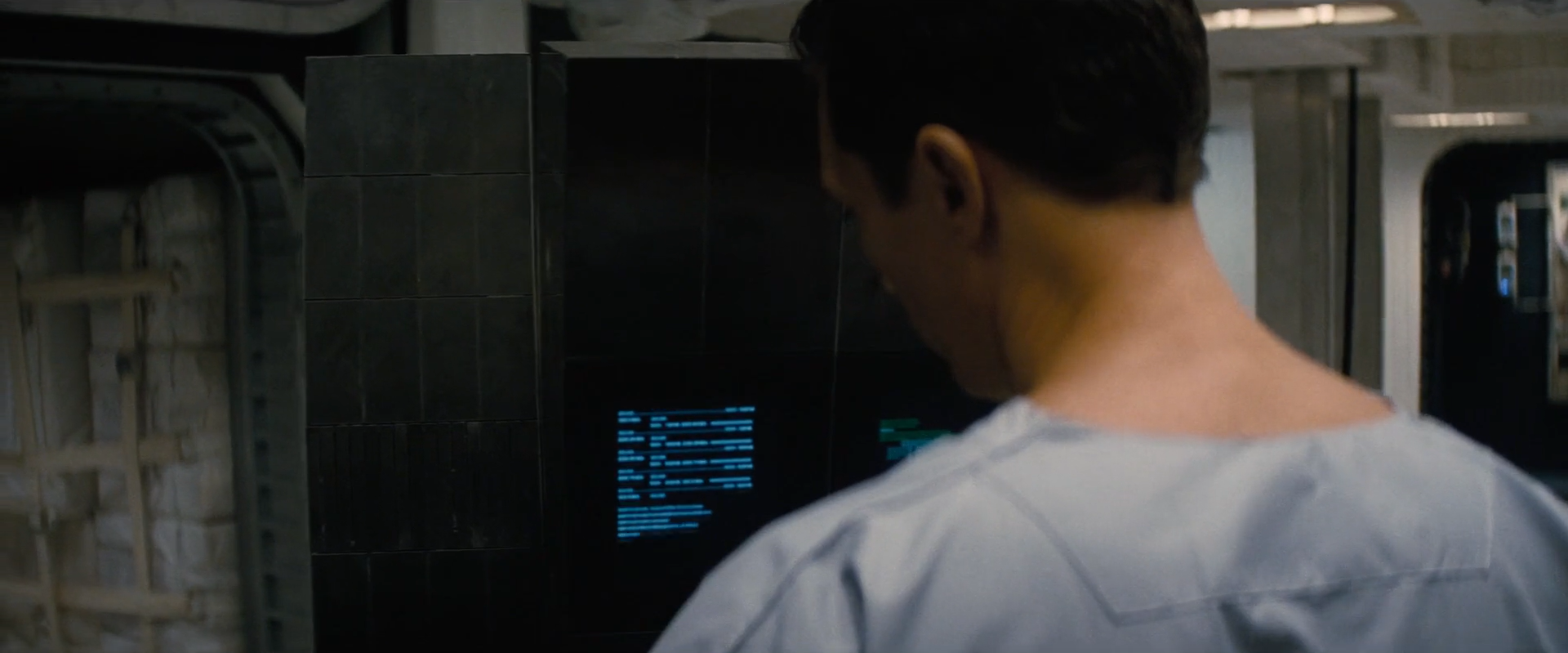
Now what? We’ve burnt off all our fuel. How are we supposed to accelerate any further? Well, the movie tells us how they plan on doing it. Not too long after their meeting with Professor Brand, Cooper asks TARS, a robot aboard the station, for their trajectory. TARS answers by saying, “Eight months to Mars, then counter-orbital slingshot to Saturn.” This is just a fancy way of saying the crew will perform a gravity assist around Mars.
Gravity assists are a way for spacecraft to accelerate by entering the gravitational influence of another body orbiting the Sun. By getting close enough to this celestial body (usually a planet), a ship can either speed up or slow down and redirect its path, using conservation of momentum. Since the mass of the planet is significantly bigger than the ship’s (by several orders of magnitude), the energy “stolen” to accelerate the ship is insignificant to the planet.
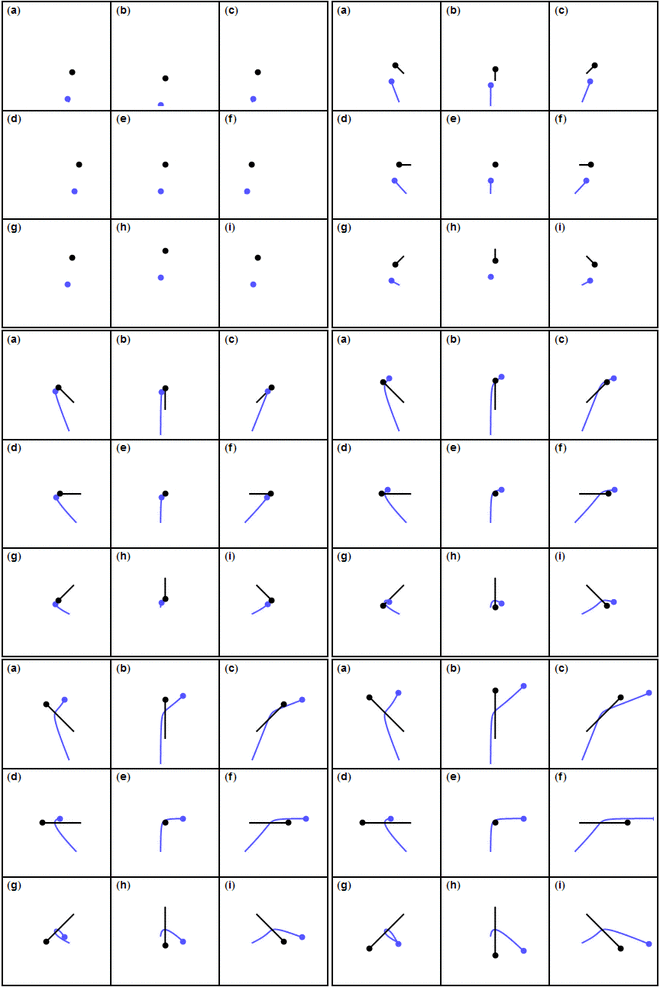
So let’s do a gravity assist around Mars, which is, on average, about 225 million kilometers away. Going at 11 km/s, it will take just under eight months, or 0.648 years, just like the movie! Now we have to travel the remaining 975 million kilometers to Saturn in just over 16 months at a speed of 22.868 km/s. The only thing we don’t know is how to approach Mars for the maneuver.
For gravity assists with a positive change in velocity, a simple equation can be used depending on the ship’s initial speed, the orbital speed of the planet (which for Mars is 24.08 km/s), and the approach angle of the ship. We can solve for the approach angle knowing the final velocity we want to take:
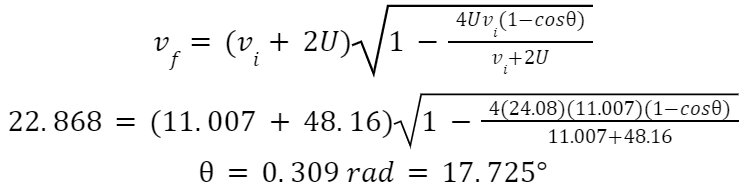
which is surprisingly sharp. It is definitely possible, but the chances that these planets, Earth, Mars and Saturn, are lined up in such a way for this path to be travelled is improbable. Granted, the wormhole in the movie appeared nearly fifty years prior to Cooper agreeing to pilot the mission. There is a chance they planned this mission at some point in advance, waiting for the planets to align. But considering that NASA, in the Interstellar universe, has been relegated to operating in secret with significantly less resources than it has today, so again, it seems improbable. Just a dash of movie magic.
Though, aren’t there G-forces that we have to take into account? That’s why we eliminated the first option we explored, so couldn’t that render this method impossible as well?
The simple answer is no. In a gravity assist, both you and the ship are being pulled by the planet’s gravity at the exact same rate. This differs from the force of thrust from the rocket or drag, as those act on only the ship and not the passengers inside. Due to this discrepancy, passengers feel a force, and if this force is too great, then fatal injuries can occur.
What if we take some of this movie magic, though, as apply it to some hypotheticals? Any fans of motor racing know that drivers experience serious G-forces, especially when they crash. In recent F1 memory, one of the biggest crashes was Max Verstappen’s at the 2021 British Grand Prix in Silverstone, where he experienced 51 G on impact. The deceleration only occurred for a fraction of a second, which allowed him to survive.
If humans could survive those forces for extended periods of time, what would happen? At the edge of the atmosphere, accelerating all the way through, we would be moving at nearly 10 km/s, or 22.3 thousand mph. It would take only twenty seconds to reach space at that acceleration, compared to the minute that it would take in real life in Starship. At that speed, it would still take 3.8 years to reach Saturn (which makes sense considering we are going slower than the first scenario we calculated).
The world record for the most Gs experienced and surviving goes to Kenny Brack, a Swedish Indycar driver who crashed at the 2003 Chevy 500 at the Texas Motor Speedway.
He lived through a 214 G crash after launching off another car, destroying his car in the crash fence. At that acceleration, our ship would be moving at 20.5 km/s, or nearly 46 thousand mph, at the edge of the atmosphere, lasting 9.76 seconds. We would reach Saturn in under two years, or 1.86 years to be exact.
Even if humans could withstand those outrageous Gs, the rocket equations holds us back. Using Starship’s parameters, the Verstappen rocket would require a wet mass of 2530 tons, almost twice what Starship can carry. Comparatively, Brack’s ship would need 61.8 thousand tons. These are both crazy amounts of fuel that would require insane engineering to work.
So, the safest and most efficient way to travel in space is through gravity assists. But you must be patient and wait, not only for your destination to arrive into prime position, but for the other planets to assist off of. Once your trip is planned, you will save both a lot of time and energy traveling to your destination. Hopefully, the pressure of saving the world won’t distract you from the wonders you would see.
If you have any space questions about other movies, shows, or even about any news happening recently, feel free to fill out questions page, and your idea might become the next article!
 Space Savvy
Leave a comment